17 February 2026
The CFA Society Italy Forecast Dinner, held in Milan on 11 February 2026, brought together a large audience of investment professionals, institutional leaders, and global market strategists for what has become the Society’s flagship annual event. Much more than a traditional outlook evening, the dinner once again positioned itself as a high-level forum designed to move beyond short-term forecasts and instead examine the structural forces shaping the investment profession and global markets.
Opening the evening, CFA Society Italy President Giuliano Palumbo, CFA, highlighted the deeper purpose of the initiative: creating a space where financial professionals can engage in substantive discussion and elevate the quality of market analysis in a time marked by technological acceleration, geopolitical fragmentation, and demographic change.
Institutional leadership and the future of financial trust
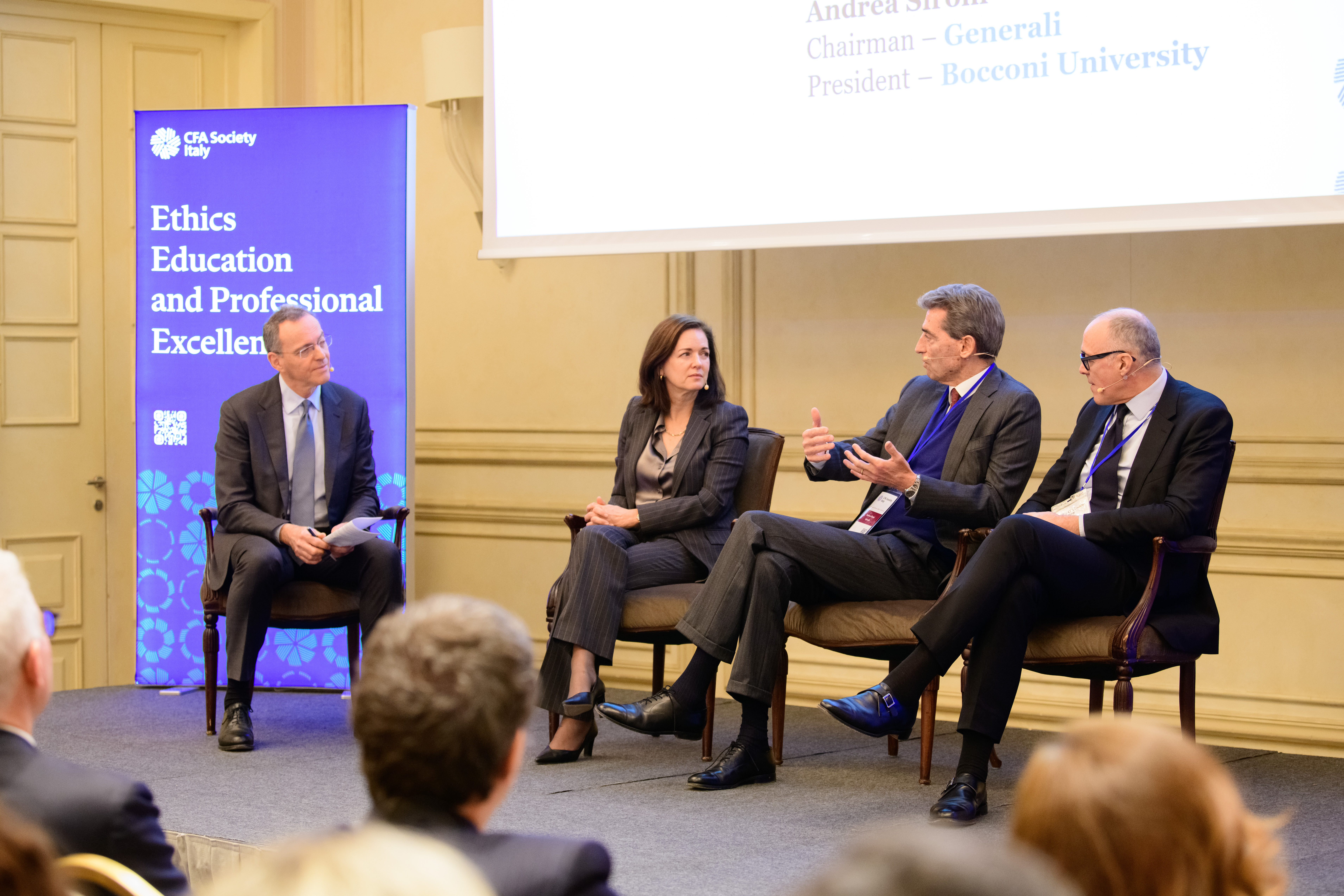
The first panel, moderated by Andrea Cabrini (Managing Editor – Class CNBC), featured Margaret Franklin, CFA President and CEO of CFA Institute, Angelo Proni, CEO of MTS, and Andrea Sironi, Chairman – Generali and President – Bocconi.
The discussion centred on the evolving role of financial institutions at a time when investor confidence is tested by rising public debt, regulatory pressure, and political fragmentation. Sironi stressed that regulation is increasingly shaping both market functioning and European competitiveness, while emphasizing the importance of professional education in strengthening the resilience of the financial system. Proni noted that digitalisation continues to redefine market structures, with technology, regulation, and investor implications forming the core challenges ahead.
Franklin offered a forward-looking perspective on the profession itself, expressing optimism about how technology, emerging talent, and a commitment to lifelong learning are reshaping investment management while reinforcing the importance of integrity and professional standards globally.
Macro and markets: selectivity replaces automatic allocation
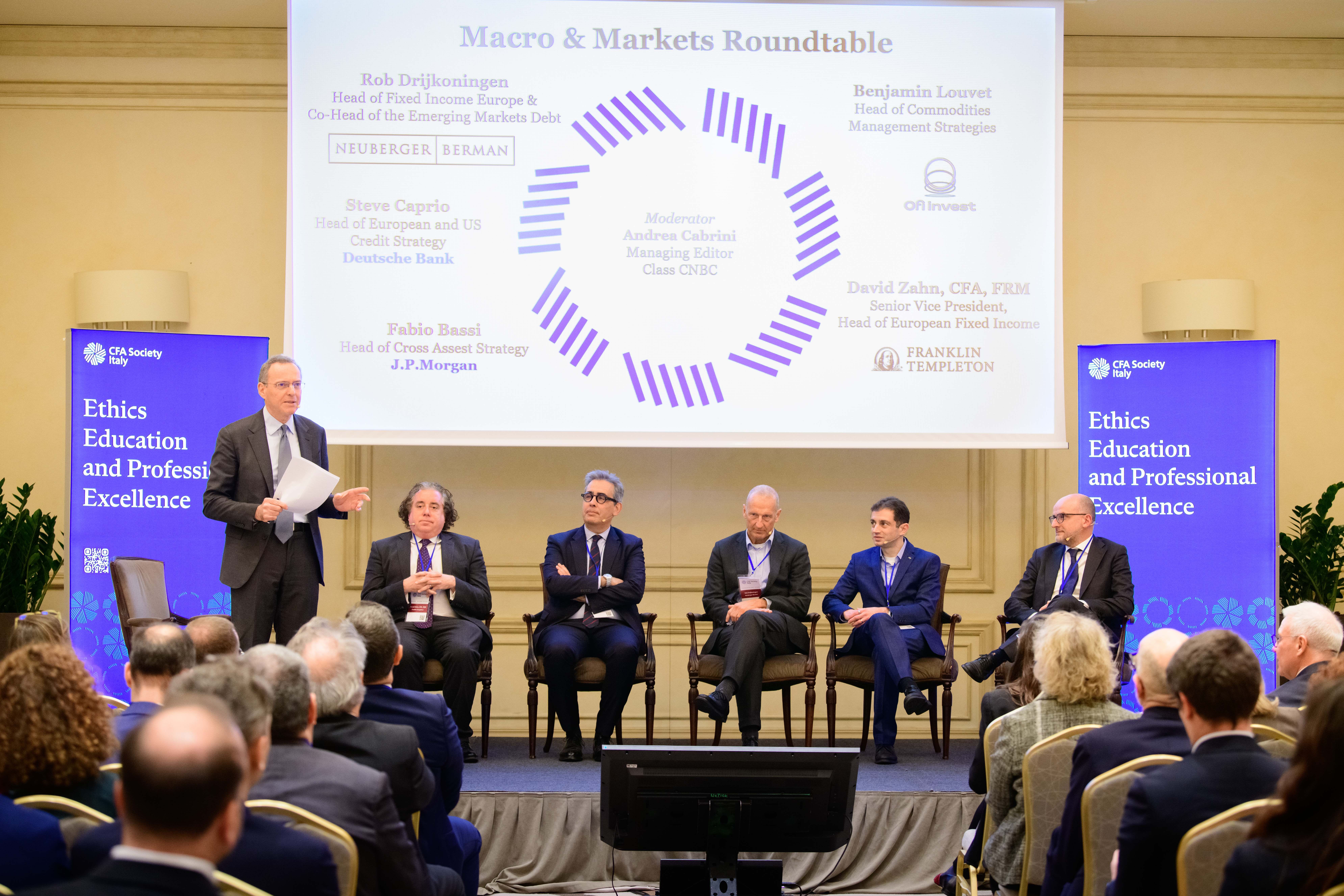
The second roundtable, again under the guidance of Andrea Cabrini, shifted the focus to macroeconomics and asset allocation, bringing together Fabio Bassi (Head of Cross Asset Strategy – J.P. Morgan), Steve Caprio (Head of European and US Credit Strategy – Deutsche Bank), Rob Drijkoningen (Head of Fixed Income Europe & Co-Head of the Emerging Markets Debt – Neuberger Berman), Benjamin Louvet (Head of Commodities Management Strategies – Ofi Invest AM), and David Zahn, CFA, CAIA, FRM, (Senior Vice President, Head of European Fixed Income – Franklin Templeton).
Across the discussion, a common theme emerged: in a volatile and structurally changing environment, asset allocation can no longer rely on historical correlations or mechanical diversification. Instead, investors must embrace selectivity, flexibility, and rigorous fundamental analysis.
Bassi described 2026 as a year of transformation shaped by monetary divergence, labour-market tensions, and the explosive expansion of artificial intelligence, requiring investors to operate in a world where risk and resilience coexist. Caprio highlighted that Europe currently benefits from supportive fundamentals and technical conditions, though investors should remain attentive to potential shocks stemming from the uneven US economic cycle.
From the fixed-income perspective, Drijkoningen warned that compressed credit spreads at the start of the year leave limited protection against shocks, making diversification beyond US-centric strategies particularly relevant. Zahn suggested that European fixed income could currently resemble a “Goldilocks” scenario characterised by stable growth, contained inflation, and renewed global investor interest. Louvet, meanwhile, underlined how structural scarcity in critical resources is forcing investors to rethink long-term commodity allocation strategies.
Instant survey: reflation leads expectations, AI risks dominate systemic concerns
Alongside the panel discussions, the evening featured a live instant survey among participants, offering a real-time snapshot of market expectations from the professional community present.
On the macroeconomic outlook for the United States, the dominant scenario among respondents was reflation, selected by 48%, indicating expectations for renewed growth with inflation remaining firm. This was followed by stagflation-lite at 20%, a soft landing at 19%, and a recession scenario at 14%, suggesting that while downside risks remain, the consensus leans toward continued expansion rather than contraction.

When asked about the primary systemic risk facing the US economy, the largest share of participants, 46%, pointed to the possibility of an AI-driven market correction linked to delayed returns on investment and stretched technology valuations. Sovereign debt and fiscal stress followed at 28%, with geoeconomic fragmentation at 21% and inflation volatility at 5%, underscoring how technological and fiscal risks now dominate investor concern.

Reflecting this shift, respondents also indicated that the transition of the AI narrative from hype to execution will likely be driven above all by a valuation reset, chosen by 39% of participants, while 29% cited liquidity pressures from large capital expenditure cycles, 20% expected a bifurcation between genuine AI winners and laggards, and only 12% anticipated a broad productivity surge in the near term.

On US Treasury yields, survey responses highlighted the growing importance of fiscal and geopolitical dynamics. The leading drivers identified were protectionist inflation linked to tariffs and trade tensions (30%) and fiscal dominance driven by record deficits and heavy bond supply (28%), followed by governance or policy-framework shifts (18%), Fed normalization (15%), and structural productivity effects from AI (10%).

Participants were also asked how markets might react if inflation rose while the Federal Reserve faced pressure to cut rates. The largest group, 37%, expected a combination of effects across asset classes, while others anticipated curve steepening (30%) or dollar depreciation (26%), confirming expectations of multi-channel market stress transmission.

Finally, when assessing the most crowded positioning risk for 2026, the top answer was the US mega-cap and AI complex, cited by 31% of respondents, followed by long precious metals positions (25%), short-dollar trades (22%), carry strategies (16%), and defense-related thematic exposure (6%). The results suggest that concentration in large technology names remains the single most closely watched positioning vulnerability.

A forum for professional dialogue and community building
The evening concluded with an extended Q&A session and networking cocktail, reaffirming the Forecast Dinner’s dual role: not only as a platform for market insight, but also as a central gathering point for CFA Society Italy’s charterholder community.
In a global environment defined by structural uncertainty, technological disruption, and shifting geopolitical dynamics, the message emerging from Milan was clear. For today’s investment professionals, returning to fundamentals is not a backward-looking exercise, but a strategic necessity: one that combines analytical rigour, ethical responsibility, and continuous professional learning.