02 November 2026
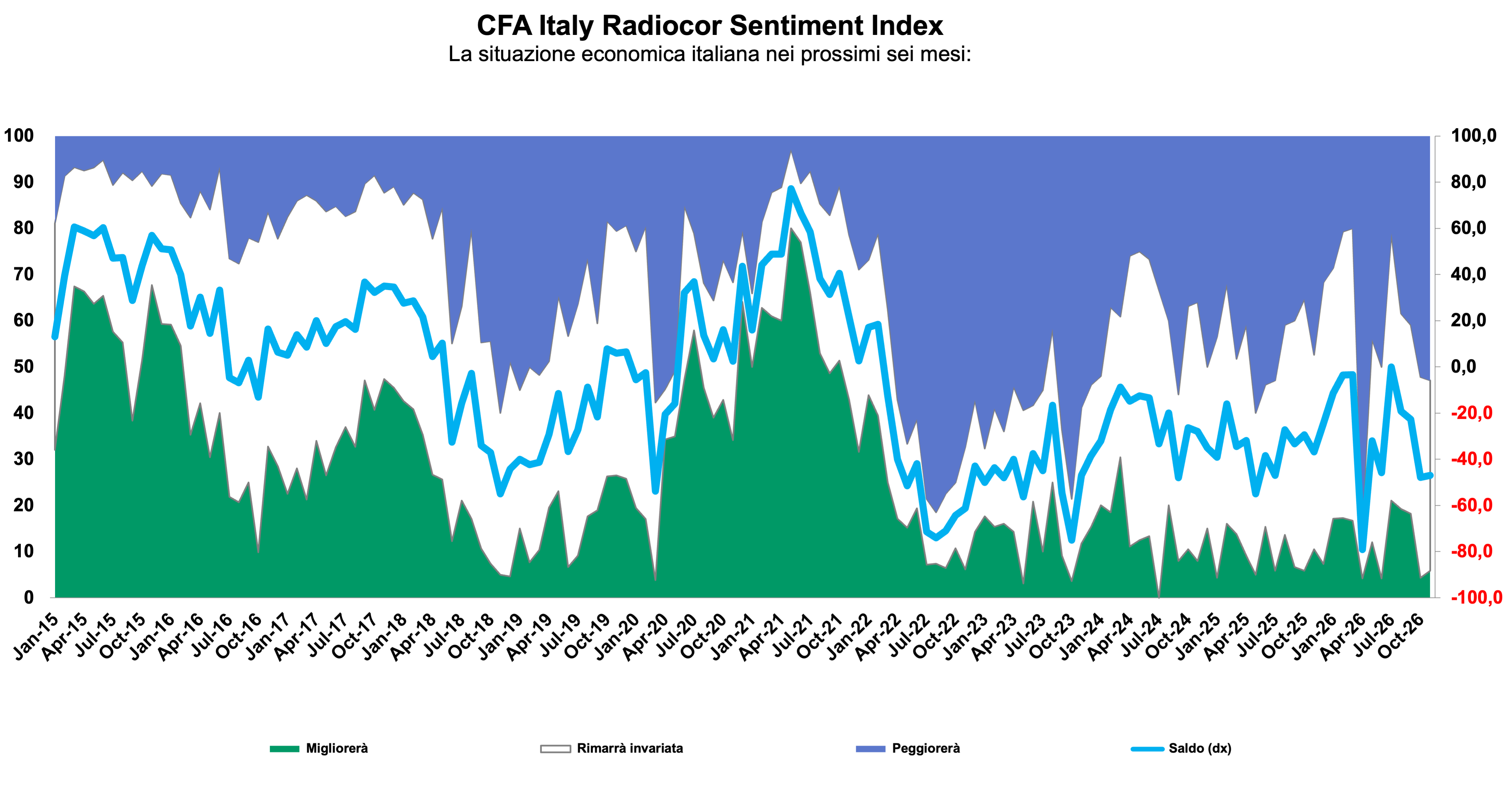
Milan, 2 November 2026 – Italian financial analysts remain cautious about the economic outlook, although concerns over inflation have eased significantly. Meanwhile, expectations for the US dollar have turned positive after several months of anticipated weakness. These are the main findings of the latest CFA Society Italy-Radiocor Financial Business Survey, conducted in collaboration with Il Sole 24 Ore Radiocor among CFA Society Italy members between 19 and 31 October 2026. The survey reveals a deterioration in assessments of current economic conditions, while expectations for the next six months remain broadly unchanged.
Economic sentiment remains deeply negative
The CFA Society Italy-Radiocor Sentiment Index stands at -47.1 points, compared with -47.8 in October, confirming persistent pessimism about Italy’s economic prospects. Only 5.9% of respondents expect the Italian economy to improve over the next six months, while 52.9% anticipate a deterioration and 41.2% foresee broadly unchanged conditions. The outlook for other major developed economies remains similarly subdued. The sentiment balance for the Eurozone stands at -41.2 points, while the US records -37.5 points, representing a slight deterioration compared with the previous survey.
Inflation expectations fall sharply
One of the most significant developments in November concerns inflation. Following the sharp increase in inflation expectations recorded in October, driven by higher gas and energy prices, analysts now anticipate a more moderate trajectory. The balance between respondents expecting inflation to rise and those anticipating a decline has fallen to -6.3 points in Italy, -12.5 points in the Eurozone and -6.3 points in the United States. The findings suggest that financial professionals increasingly regard the recent energy-related inflation pressures as temporary. This shift is also reflected in interest rate expectations. Although respondents still expect higher short-term rates over the next six months, the degree of conviction has weakened considerably. The balance for short-term interest rates stands at 58.8 points in Italy, 64.7 in the Eurozone and 47.1 in the United States. Expectations for long-term yields have also moderated, with balances of 17.6 points in Italy and 5.9 points in both the Eurozone and the United States.
Equity markets: caution persists, particularly in Europe
Equity market expectations remain predominantly negative, with sentiment towards Italian stocks deteriorating further. The FTSE MIB records a balance of -41.2 points, while the FTSE STAR stands at -35.7 points. The Euro Stoxx 50 also remains in negative territory at -29.4 points. The outlook for US equities is comparatively more encouraging. Sentiment towards the S&P 500 has recovered to zero, reversing the pronounced pessimism observed in the previous survey. At sector level, Italian banks continue to attract the most positive expectations, with a balance of 20 points, although this represents a substantial decline compared with October. Utilities retain a moderately positive balance of 6.7 points, while expectations for insurance and oil companies are neutral. The weakest outlooks concern construction (-71.4 points), automotive (-42.9 points) and machinery (-35.7 points), highlighting the selective nature of investors’ expectations across the Italian market.
US Dollar expectations turn positive as oil outlook weakens
A notable reversal has emerged in foreign exchange expectations. After several months in which analysts anticipated a depreciation of the US dollar against the euro, sentiment has shifted towards appreciation, with the balance rising to 12.5 points. Expectations for the Japanese yen have strengthened further, reaching 46.7 points, the highest balance among the major currencies monitored by the survey. Meanwhile, the outlook for oil prices has become markedly more bearish. 68.8% of respondents expect oil prices to decline over the next six months, compared with just 18.8% anticipating an increase. The resulting balance of -50 points is the most negative recorded in recent months.
The survey therefore presents a mixed picture: economic expectations remain weak and European equity markets continue to face considerable scepticism, but easing inflation concerns and a less pronounced outlook for interest rate increases suggest that some of the pressures weighing on financial markets may be moderating.